

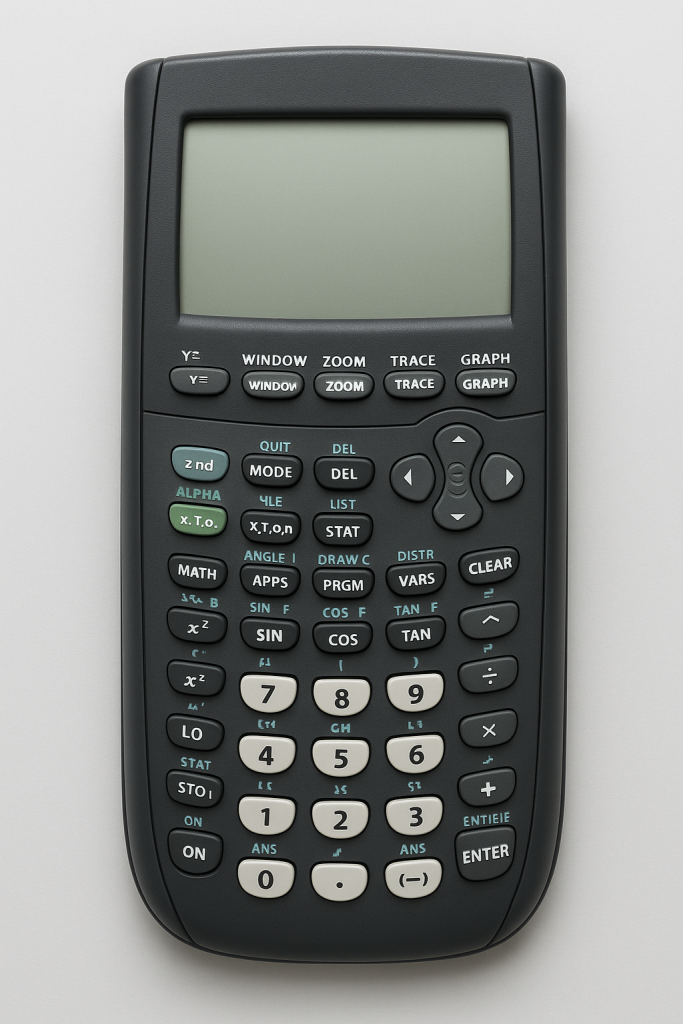
Multiple AP subjects, such as math and science, require complex mathematical calculations to solve problems. College Board permits the use of calculators for such exams. However, if not used efficiently, students can lose critical time on their exams navigating the calculator functionality. Calculators require prior understanding of operating, with a high level of competency needed to apply them on the College Board AP exams. College Board officially divides calculator usage policies into three subcategories: calculator required, calculator permitted, and calculator not allowed.
Why Does College Board Permit Calculators?
As a way to mirror academic rigor and standards from college-level coursework, College Board sees value in students using different types of calculators to work through their solutions. For math AP exams like Statistics and Calculus, where students might be given large numbers or decimals, it is time-saving and better practice to use calculators to carry out multiple steps in solving a given problem.
Although the College Board wants students to learn how to use calculators, it still expects them to think critically and be able to solve problems algorithmically. Let’s dive into some of the AP exams that surprisingly do not require a calculator, and why they don’t.
AP Exams with “No Calculator” Policy
Calculators are allowed for all math AP exams, but not for the computer science ones (Computer Science Principles & Computer Science A). The two exams test a student on a variety of computer science topics, but they focus mainly on abstract programming logic and problem-solving skills.
College Board intentionally enforces a no-calculator policy on these exams to engage students in logical and sophisticated algorithmic design. Rather than relying on computation, these exams assess a student’s ability to manipulate and creatively articulate robust programs that achieve a desired function.
Calculator Allowed – Policies for Certain AP Exam Subjects
AP exams that do permit calculator usage include AP Biology, AP Calculus AB/BC, AP Chemistry, AP Environmental Science, AP Macroeconomics, AP Microeconomics, AP Physics 1/2/C, AP Precalculus, and AP Statistics.
For the types of calculators allowed on each exam, visit this link to learn more.
All three types of calculators (4-function, scientific, graphing) will now be available for any student to use on Bluebook, depending on the exam. With this change, College Board is minimizing friction between the student, their interface, and their solutions to a given problem on exam day.
Strategies for Calculator Usage on Math AP Exams
On Math AP exams like Calculus AB/BC and Statistics, knowing how and when to use your calculator is imperative to performing well on the AP exams.
AP Calculus AB/BC:
For Calculus AB/BC, the free-response section is split into two parts: Part A – Calculator Required and Part B – No Calculator. Utilizing a calculator on calculus is necessary to simplify numerical integration expressions and quickly evaluate definite integrals that would be time-consuming to work out by hand.
Additionally, using the “nDeriv” calculator functionality for derivatives, particularly for complex polynomials, is useful in finding different types of information. For example, when inputting expressions on a graphing calculator dealing with complex functions for which you need to find the derivative at a specific point, you can tangibly visualize the graph. On the graph, you can identify critical points and concavity patterns, which give crucial insight into mathematical abstractions within calculus.
In terms of when to use your calculator, use it to check your work, especially graphs. Verifying answers that deal with derivatives can be checked against graphs, to see if you are in a reasonable range. If your answer does not align with what you see on the graph, then you know you will need to revisit the problem and work through it again.
AP Statistics:
For AP Statistics, calculators are used for a different purpose than calculus. Rather than traditional computing, students utilize calculators to familiarize themselves with statistical functions. This can include plotting (box plots, scatter plots, histograms) and regression features (linear/exponential regression, correlation coefficients).
Calculators are also used for probability distributions and related areas (chi-square tests, t-tests, confidence intervals). For hypothesis testing, calculators have built-in functions to compute test statistics and p-values, enabling conclusions to be drawn about specific tests.
The main takeaway from this section is to be competent in using different functions within a calculator, based on which math AP exam you are taking. Also, using a calculator at certain times, like checking an answer, can be beneficial for getting accurate solutions, so you don’t miss out on those points!
Practice on Our Platform
For other AP exams, calculator usage varies case-by-case, but a general rule of thumb is that calculators are vastly unused for most of the test and only if you need to work with big numbers.
On the Magna Education platform, we offer AP subjects ranging from Biology to Statistics. Within these subjects, we have plenty of practice quizzes that span over 1,000 questions, some of which do and don’t require a calculator to solve.
To start putting your calculator knowledge and skills into practice, head over to magnaeducation.ai and start unpacking our top-of-the-line questions today!