

Feeling overwhelmed by the AP English exam? Let’s be honest: facing dense passages and the pressure to write a brilliant essay on the spot can leave even the best students staring at a blank page. You’re not alone in that test-day anxiety, but what if you could trade that stress for strategic confidence? Over the last couple of years, Magna Education has helped thousands of students do just that, and based on self-reported scores, 89% of their AP exams resulted in a a 4 or a 5. This isn’t just another textbook; it’s your personal training plan.
This comprehensive ap english exam study guide is engineered to give you a clear, actionable framework for success. We’ll break down both the AP English Language and AP English Literature exams into manageable pieces, moving beyond generic advice to show you exactly what graders are looking for. Our goal is to equip you with the analytical habits and instincts to master rhetorical analysis, craft compelling arguments under pressure, and decode complex literary texts, ensuring you’re prepared for whatever the College Board throws at you.
Your Path to Conquering the AP English Exam
Most guides throw generic advice at you. We’re going to give you actionable frameworks and a peek behind the curtain at what the graders are actually looking for. This is your step-by-step plan for mastering the skills that matter.
We’ll zero in on the big three:
- Mastering rhetorical analysis for those tricky non-fiction texts.
- Crafting compelling, evidence-backed arguments—even when you’re short on time.
- Decoding complex poetry and literary prose without getting lost in the weeds.
The goal here isn’t just to memorize a bunch of literary terms. It’s about developing the analytical habits and instincts that lead to a high score, no matter what prompt the College Board throws at you.
By focusing on these core skills, you’ll build a versatile foundation that works for both exams. You’ll move from feeling uncertain to feeling prepared, ready to walk into that exam room and show them what you can do.
Decoding the Exam Structure and Scoring System
Before you can build a winning game plan for either AP English exam, you first need to understand the field of play. Both the Language and Literature exams share a similar blueprint, split into two major sections that test related, but distinct, skills. Think of it like a triathlon—one part is a fast-paced sprint, while the other is an endurance event that demands deep thinking and careful construction.
The entire exam, for both subjects, clocks in at 3 hours and 15 minutes. That time is divided between a multiple-choice section and a free-response section, and you’ve got to be ready for both. Knowing how the timing and scoring break down is the first step toward creating a study guide that actually works.
The Two Halves of the Test
At its core, the test is a tale of two sections. Each one requires a completely different mindset, so it’s critical to prepare for the rapid-fire analysis of multiple-choice just as much as the sustained argumentation of the essays.
Section I: Multiple-Choice (MCQ): This is the sprint. You’ll have 1 hour to tackle 45 questions, which account for 45% of your total exam score. The goal here is to read several passages and answer questions testing your ability to analyze everything from rhetoric and style to argumentation.
Section II: Free-Response (FRQ): This is the marathon. You get 2 hours and 15 minutes to write three completely different essays. You get 15 minutes of reading time followed by 120 minutes of writing time. This section makes up the remaining 55% of your score, making it the single most important part of the exam.
The essays are where you really get to show off your analytical muscles. While the multiple-choice section tests how well you can spot literary and rhetorical techniques, the FRQs are your chance to build a sophisticated, evidence-backed argument from the ground up.
Breaking Down the Free-Response Questions
While both exams feature three essays, the specific prompts are tailored to each course’s focus. Knowing exactly what to expect prevents any nasty surprises on test day and lets you practice with purpose.
For AP English Language & Composition, you’ll tackle:
- Synthesis Essay: You’ll be given a handful of sources and tasked with developing an argument that synthesizes information from at least three of them to support your own position.
- Rhetorical Analysis Essay: Here, you’ll analyze how an author’s specific rhetorical choices contribute to the overall meaning and purpose of a non-fiction text.
- Argument Essay: You’ll be presented with a debatable claim and asked to write an essay arguing your own stance, pulling evidence from your own knowledge, reading, and experience.
For AP English Literature & Composition, the essays are:
- Poetry Analysis Essay: You will analyze a given poem for its literary elements, structure, and meaning.
- Prose Fiction Analysis Essay: This essay asks you to analyze a passage from a short story or novel, digging into character, theme, and style.
- Literary Argument Essay: You’ll respond to a thematic prompt by developing a strong argument using a full-length work of literature (novel or play) of your own choosing.
This chart gives you a quick look at the point distribution for the AP English Language exam, showing where the bulk of your score comes from.
As you can see, mastering the multiple-choice section is essential, as it holds nearly half of the total points on the table.
AP English Language vs AP English Literature Exam Breakdown
While the AP English Language and Literature exams share a similar framework, the content and essay types are quite different. Here’s a side-by-side look at what to expect from each.
| Component | AP English Language & Composition | AP English Literature & Composition |
|---|---|---|
| Total Time | 3 hours, 15 minutes | 3 hours, 15 minutes |
| Section I: MCQ | 1 hour, 45 questions (45% of score) | 1 hour, 55 questions (45% of score) |
| MCQ Focus | Rhetorical analysis of non-fiction texts | Literary analysis of poetry, drama, and prose fiction |
| Section II: FRQ | 2 hours, 15 minutes, 3 essays (55% of score) | 2 hours, 3 essays (55% of score) |
| Essay 1 | Synthesis Essay (using provided sources) | Poetry Analysis Essay |
| Essay 2 | Rhetorical Analysis Essay (of a non-fiction passage) | Prose Fiction Analysis Essay |
| Essay 3 | Argument Essay (developing your own position) | Literary Argument Essay (using a work of your choice) |
Understanding these distinctions is key to tailoring your study plan to the specific exam you’re taking.
From Raw Points to Your Final Score
Your performance on both sections generates a raw score. The College Board then works its magic, converting that raw score into a composite score, which finally translates to that familiar 1–5 scale. A score of 3 or higher is generally considered “passing” and is the benchmark for earning college credit at many universities.
Getting a top score is tough, but it’s far from impossible. In a recent year, for AP English Language & Composition, 13.4% of students scored a 5, while an impressive 74.2% earned a passing score of 3 or higher. The story is similar for AP English Literature & Composition, where 16.2% scored a 5 and 74.1% passed.
These numbers prove that with focused prep, a majority of students find success. You can always explore more about AP score distributions to see how students performed across every subject.
Mastering the Multiple-Choice Section

Let’s be real: the multiple-choice section of the AP English exam is less of a reading quiz and more of a test of your analytical agility under a serious time crunch. This section accounts for a hefty 45% of your total score, so you can’t just wing it.
You have a mere 60 minutes to tackle 45 questions. That breaks down to about 80 seconds per question, which isn’t a lot of time to read a complex passage, analyze the question, and weigh the answer choices. This pace demands a solid, repeatable method. You need to shift from being a passive reader to an active interrogator of every text you see.
Deconstructing the Question Types
Not all multiple-choice questions are built the same. They’re specifically designed to test a wide range of analytical skills, from your grasp of the big picture down to nit-picky stylistic details. Figuring out these categories helps you anticipate what the test makers are actually asking.
The questions mostly fall into two big buckets:
- Reading Questions: These make up the majority of the section (23-25 questions). They focus on your ability to break down rhetorical situations, claims, evidence, and stylistic choices within several non-fiction passages.
- Writing Questions: This batch (20-22 questions) gives you draft passages and asks you to play editor. They test your understanding of how to build a coherent argument, sharpen sentence structure, and improve word choice for a specific audience.
Think of it this way: Reading questions ask you to analyze what an author has done, while writing questions ask you to decide what an author should do. Getting this distinction is central to building an effective ap english exam study guide strategy.
Active Reading Strategies for the Digital Age
One of the biggest mistakes students make is simply reading the passages from top to bottom and then trying to answer the questions. You need a more active approach to pull out the important stuff efficiently. Since you can’t physically mark up a digital exam, you have to get good with digital tools and mental frameworks.
A game-changing technique is to read with a purpose. Before you even start the passage, quickly scan the questions that go with it. This primes your brain to hunt for the specific details, rhetorical devices, or tone shifts you know you’ll be asked about.
As you read, mentally “tag” the key components:
- The Main Claim: What’s the author’s central argument?
- Purpose: Why did they write this? To persuade, inform, satirize?
- Audience: Who are they talking to, and how does that shape their language?
- Tone Shifts: Where does the author’s attitude change? Watch for transition words.
- Strong Verbs and Imagery: Notice the powerful language that gives away the author’s stance.
This mental annotation creates a quick map of the passage, making it way easier to find evidence when you’re answering the questions. The recent shift to digital AP exams has changed the game, with the College Board continuing to expand the digital AP exam formats. This move has brought new security measures and scoring methods you need to be aware of. You can learn more about the new era of digital AP exams and what it means for you.
Spotting Common Traps and Distractors
The test makers are masters of disguise, creating answer choices that look right but are designed to trick you. Learning to spot these common distractors is a critical skill for boosting your accuracy and saving precious time.
Here are the most common traps you’ll see:
- Too Broad: This answer choice is a sweeping generalization that isn’t really supported by the passage. It might be a true statement in general, but it doesn’t fit the specific text.
- Too Narrow: This choice hones in on a tiny detail from one part of the passage but completely misses the bigger picture the question is asking about. It’s often technically correct but not the best answer.
- The “Half-Right” Answer: This is the sneakiest trap of all. One part of the answer is perfect and text-supported, but another part is subtly wrong, which makes the whole thing incorrect.
- Out of Context: This answer lifts words or phrases straight from the passage but twists their meaning or applies them in a way the author never intended.
When you’re stuck between two options, go back and re-read the question itself. Then, find the exact lines in the passage it refers to. The correct answer will always be the one that is 100% supported by the text—not 50% or even 90%. Your ability to tell the difference between a “good” answer and the “best” answer is what will push your score to the next level.
How to Write High-Scoring Free-Response Essays
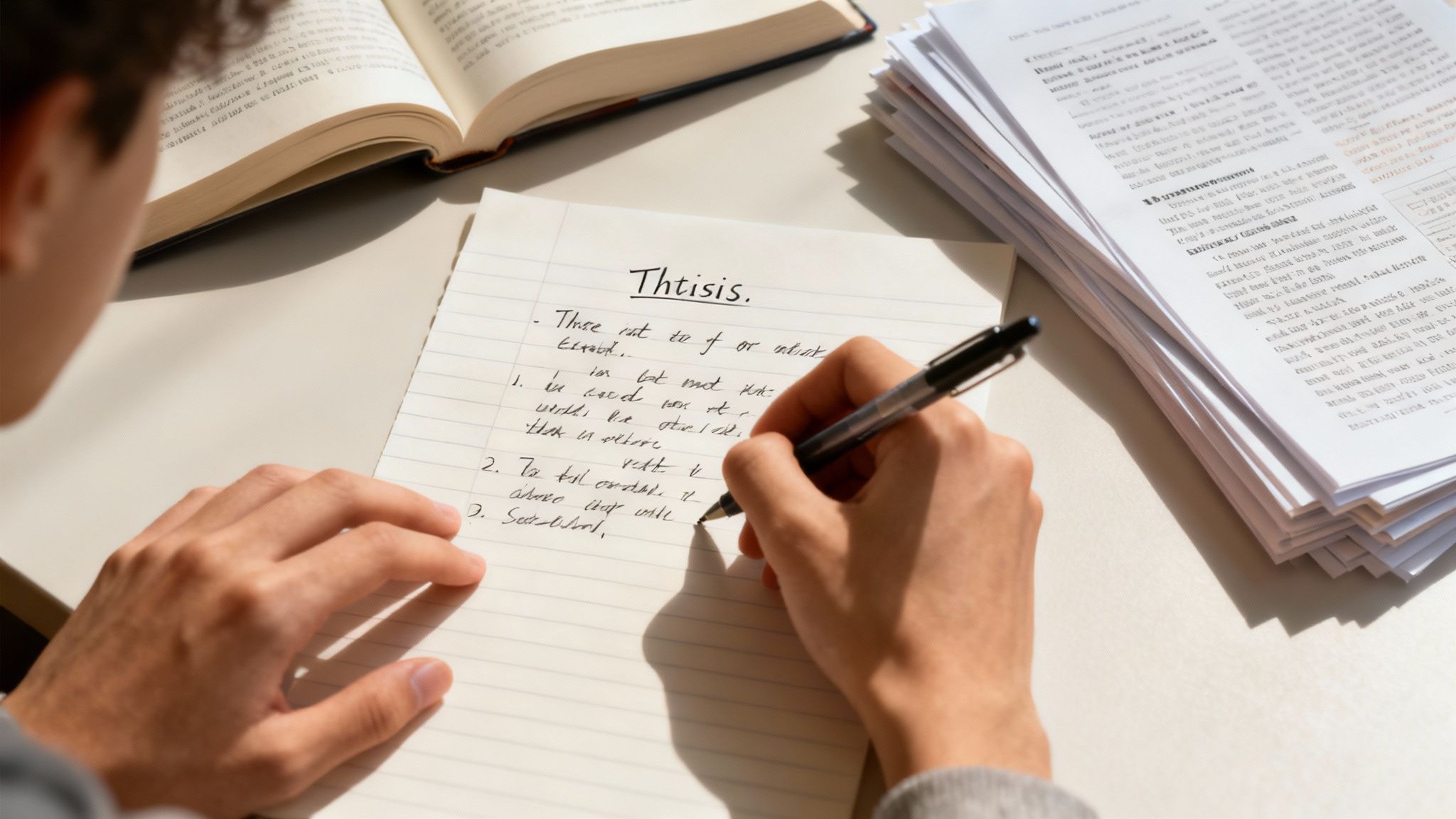
Let’s talk about the heart of the AP English exam: the Free-Response Question (FRQ) section. This is where your analytical muscles really get to flex. It’s a huge part of your grade, making up a massive 55% of your total score, so getting it right is non-negotiable for a top result.
Success here isn’t just about writing fast; it’s about building a powerful, convincing argument. You need a solid game plan for breaking down prompts, crafting a killer thesis, and choosing the perfect evidence. Each of the three essays has its own personality, whether you’re taking AP Lang or AP Lit.
The Universal Foundation: A Defensible Thesis
Before we get into the nitty-gritty of each essay, we have to talk about the single most important sentence you’ll write: your thesis. A shaky thesis guarantees a shaky essay, plain and simple.
Graders are trained to hunt for a defensible claim. This isn’t just a topic sentence; it’s an argument that you can back up with solid proof from the provided texts or sources. It needs to be specific, arguable, and lay out a clear path for your essay.
Think of your thesis as the engine of your essay. It’s not just stating a fact; it’s making a specific, analytical claim that the rest of your essay is dedicated to proving. For instance, instead of saying, “The author uses rhetorical devices,” a thesis with teeth would be something like, “The author’s use of confrontational diction and anecdotal evidence systematically challenges the audience’s preconceived notions about economic inequality.” See the difference?
Cracking the Code of the Synthesis Essay (AP Language)
The Synthesis essay is a unique challenge. You’re not just writing an essay; you’re stepping into an ongoing conversation. You’ll get a handful of sources on a topic and your job is to develop your own argument, using at least three of them as your evidence.
The biggest trap students fall into? Just summarizing the sources one by one. Don’t do it.
Instead, picture yourself as the moderator of a panel discussion. You need to skillfully weave the sources together, pointing out where they agree, where they clash, and where they add nuance—all to support your central argument.
Here’s a simple framework to follow:
- Deconstruct the Prompt: Figure out the core question you’re being asked to tackle.
- Analyze the Sources: Speed-read and annotate each source. Group them by perspective—who’s for, who’s against, and who’s in the middle?
- Formulate Your Thesis: Now, what’s your take? Your position should drive the essay, not the other way around.
- Outline Your Argument: Structure your paragraphs around your claims, not the sources. Then, plug in the best source evidence to back up each point.
This method keeps your voice front and center. For a deeper dive into different FRQ approaches, check out our guide on how AP exam FRQs work.
Nailing the Analysis Essays (Rhetorical and Literary)
Both the Rhetorical Analysis (AP Lang) and Literary Analysis (AP Lit) essays are all about explaining how an author’s choices create meaning. The secret is to constantly connect the “what” (specific evidence) with the “so what” (your insightful commentary).
For a Rhetorical Analysis essay, you’re playing detective, figuring out how an author uses language to achieve a specific purpose with a specific audience. You’ll want to focus on things like diction, syntax, imagery, and tone.
For a Literary Analysis essay on a piece of prose or poetry, you’re exploring how literary elements like characterization, setting, or symbolism build a complex theme.
In both essays, your body paragraphs should have a clear, repeatable rhythm:
- Claim: A topic sentence that makes a sharp point tied to your thesis.
- Evidence: A direct quote or a specific, well-chosen detail from the text.
- Commentary: This is where the magic happens. Explain how that evidence proves your claim and ties back to your big-picture argument. Don’t just rephrase the quote!
Conquering the Argument Essays (Language and Literature)
The Argument essay (for AP Lang) and the Literary Argument essay (for AP Lit) ask you to build a case almost entirely from your own knowledge. The Language prompt gives you a debatable idea, while the Literature prompt asks you to analyze a theme using a major work you’ve read.
The real test here is pulling strong, specific evidence out of thin air. Vague ideas won’t fly. Before you even think about writing, brainstorm a quick list of evidence from:
- History and current events
- Science and pop culture
- Personal experience (used wisely!)
- Other books, articles, or films you know well
For the Literary Argument, pick a book or play that perfectly fits the prompt. You need to know it inside and out—plot points, character arcs, key symbols—to make a compelling case.
What High-Scoring Essays Have in Common
No matter the prompt, AP graders are looking for the same core ingredients. We’ve broken down exactly what they want to see in the table below.
Key Elements of a High-Scoring AP English Essay
This table is your cheat sheet for understanding what graders reward. From the thesis to that elusive sophistication point, here’s the breakdown.
| Rubric Component | What Graders Want to See | Pro Tip for Success |
|---|---|---|
| Thesis (1 point) | A clear, defensible claim that directly answers the prompt and establishes a line of reasoning. | Push beyond just rephrasing the prompt. Make an actual argument that needs to be proven. |
| Evidence & Commentary (4 points) | Specific, relevant evidence that is woven smoothly into your argument and followed by insightful commentary. | Always ask yourself, “So what?” Explain why the evidence you chose matters to your overall point. |
| Sophistication (1 point) | A nuanced argument, a vivid writing style, or a deep understanding of the rhetorical or literary situation. | Acknowledge a counterargument or explore a tension within the text. It shows you’re a complex thinker. |
That “sophistication point” is tough to get, but it’s what separates the 4s from the 5s. Don’t obsess over it, but if you focus on building a nuanced argument and writing with precision, you just might snag it.
Building Your Personalized Study Plan
https://www.youtube.com/embed/RfibMaQHFYk
Let’s be real: a generic, one-size-fits-all approach to the AP English exam is a recipe for disappointment. Success isn’t about logging endless hours with a textbook; it’s about having a smart plan that zeros in on your specific strengths and weaknesses.
The first step in building an effective ap english exam study guide is to run a quick, honest diagnostic on yourself.
Grab a full-length, timed practice exam from an official College Board source and simulate test day. When you’re done, don’t just tally up the wrong answers. Dig deeper. Analyze the types of mistakes you’re making. Are you consistently running out of time on the multiple-choice section? Is your thesis statement always a bit too vague? Do you struggle to pick out compelling evidence for your essays?
Pinpointing these patterns is everything. Once you know exactly where you’re dropping points, you can build a schedule that targets those areas relentlessly. This turns your study time from a guessing game into a focused, strategic mission.
Designing Your Study Timeline
Your timeline is the backbone of your entire prep. Whether you have three months or just a few weeks, a structured plan is your best defense against last-minute cramming and the anxiety that comes with it. A longer runway gives you time for deep content review, while a shorter one demands a laser focus on the most critical skills.
Here are three simple frameworks you can adapt:
- The 3-Month Marathon: This is the ideal scenario for thorough prep. Use the first month to review core concepts and practice individual skills. Dedicate the second month to applying those skills in timed practice sections. Save the final month for full-length practice exams and an intensive review of every single mistake.
- The 6-Week Sprint: With less time on the clock, you need to be strategic. Spend the first two weeks attacking your single biggest weakness from your diagnostic test. Use the next two weeks on your second-biggest weakness, mixing in plenty of timed FRQ practice. The final two weeks are all about full-length exams and error analysis.
- The 2-Week Cram Session: Okay, this is damage control territory. Focus exclusively on timed practice and quick reviews of the major rubric requirements. Your goal isn’t to learn new content from scratch but to build endurance and lock in your test-day strategies.
No matter which timeline you pick, consistency is king. A dedicated 45 minutes every day is far more powerful than a five-hour panic session once a week. Building good habits is just as important as mastering the content.
Choosing the Right Study Resources
There’s a reason the market for AP English study guides is a multi-million dollar industry. Surveys show that most students buy at least one prep book or online tool, with costs ranging from $20 to over $200. It’s a clear sign that students are looking for resources that offer targeted, effective preparation. You can discover more insights about AP exam trends and statistics.
But not all resources are created equal. Here’s how to build a smart toolkit:
- Start at the Source: Your first stop should always be the College Board website. They offer tons of free, officially released FRQ prompts, detailed scoring rubrics, and real student essay examples. This is the gold standard.
- Pick a High-Quality Prep Book: Look for a book from a trusted publisher that offers multiple full-length practice tests and, more importantly, detailed answer explanations. The explanations are where the real learning happens—they’re often more valuable than the questions themselves.
- Use Digital Tools for Targeted Drills: Certain online platforms have question banks tagged by skill, which is perfect for zeroing in on your weak spots. If you constantly struggle with identifying an author’s tone, you can drill those specific types of questions until they become second nature.
For students who prefer to pave their own way, having a well-organized plan is non-negotiable. You can learn more by reading our guide on effective strategies for AP exam self-studying. By combining official College Board materials with a solid prep book and some smart digital tools, you’re not just studying—you’re creating a personalized roadmap that leads straight to your target score.
Essential Time Management and Test Day Strategies
On exam day, how you manage the clock is just as important as how well you know rhetorical analysis. Think of your time management strategy as the invisible thread tying all your knowledge together. It ensures you actually get the chance to show the graders everything you’ve learned.
Without a solid plan, even the most prepared student can feel the pressure, get rushed, and make simple mistakes. The trick is to stop thinking of the exam as one massive 3-hour and 15-minute marathon. Instead, see it as a series of smaller, manageable sprints. That mental shift is everything.
Pacing the Multiple-Choice Section
You have just 60 minutes to tackle 45 multiple-choice questions. That boils down to about 80 seconds per question, which isn’t a lot of time when you factor in reading the passage itself. The goal isn’t to spend exactly 80 seconds on each one, but to keep a steady rhythm.
Here’s a simple, battle-tested approach:
- Don’t Get Bogged Down: If a question has you completely stumped, take your best educated guess, flag it, and move on. Burning five minutes on one tough question could cost you several easier points down the line.
- Bank Time on the Easy Wins: Some questions will feel like softballs. Answer them quickly and confidently. This builds up a small time cushion you can use on the more complex questions later.
- Use Mental Checkpoints: Every 15 minutes, you should be about a quarter of the way through. A quick glance at the clock keeps you honest about your pace and lets you know if you need to speed up.
The single biggest mistake students make is getting stuck on one passage. Remember, every question is worth the same amount. It’s far better to answer 40 questions with confidence than to perfectly analyze two passages and run out of time for the rest.
A Timing Framework for the Essays
The Free-Response section gives you 2 hours and 15 minutes for all three essays. While the College Board suggests spending about 40 minutes per essay, you can break that down even further to make sure each essay gets the attention it deserves.
Here’s a proven framework to use for each 40-minute essay block:
- Plan (5-7 minutes): This is non-negotiable. Tear apart the prompt, read and mark up the text, and scribble a quick outline. This planning phase is the best investment you can make for a high-scoring essay.
- Write (30-32 minutes): Now, it’s time to execute. Focus on getting a strong thesis down and then build out your body paragraphs with clear evidence. Don’t obsess over making every sentence perfect—just get your core ideas on the page.
- Proofread (3 minutes): Use the last few minutes to hunt for glaring typos, fix clunky sentences, and make sure your main points are clear. A quick polish can make a huge difference in your final score.
Getting comfortable with these pacing strategies is a key part of any good ap english exam study guide. For a deeper dive, check out our guide on effective time management for AP students. This approach helps you stay calm and in control, ensuring you have enough time to knock every essay out of the park.
Frequently Asked Questions About the AP English Exam
Even after weeks of studying, there are always a few nagging questions that pop up. Let’s tackle some of the most common uncertainties students have so you can walk into exam day with total confidence.
Which AP English Exam Is Harder: Language or Literature?
Honestly, neither exam is universally “harder”—they just test different analytical muscles. Think of it this way: AP Language is for the debater, the student who loves picking apart an argument and understanding persuasive techniques in non-fiction. AP Literature, on the other hand, is for the interpreter, the student who loves digging into the deeper themes and symbols in fiction and poetry.
Your success really hinges on your personal strengths and which type of reading you genuinely enjoy. The official scoring data from the College Board backs this up, showing that both exams have very similar pass rates and difficulty levels every single year.
How Many Practice Tests Should I Take?
This is a classic case of quality over quantity. Aiming for 3 to 5 full-length, officially released practice tests is the sweet spot for most students. But remember, the test itself isn’t where the learning happens. The real magic is in the review process afterward.
For every single question you miss (or even just guess on!), you need to dig in and figure out exactly why the correct answer is right and, just as importantly, why the other choices are wrong. For your essays, grade them brutally using the official rubrics. Look for patterns in your writing that are holding you back.
Can I Use Outside Knowledge on the Synthesis Essay?
Yes, but with a big asterisk. You have to be strategic about it. Your main job is to construct an argument using the sources they give you—that’s non-negotiable.
However, weaving in a relevant piece of outside knowledge or a quick, fitting personal story can be the very thing that elevates your essay and snags you that elusive sophistication point. Use it to add a layer of context or a unique example that powerfully reinforces a point you’re already making with the provided texts. A top-scoring essay is always built on the foundation of the sources, but it can be supercharged by your broader awareness of the topic.
Ready to turn all that hard work into the score you deserve? Magna Education creates personalized AI-driven study plans, generates endless AP-style practice, and gives you the instant feedback you need to master the test. Check out a smarter way to prep at https://magnaeducation.ai.