

Feeling crushed by the sheer volume of content in AP Environmental Science? From biogeochemical cycles to global climate change, it feels like a mountain of information to memorize. Many students struggle to connect the dots between the nine different units, leading to anxiety about the complex, multi-part questions on the APES exam. This isn’t just about knowing facts; it’s about applying them to solve real-world environmental problems, a skill that’s tough to master alone. If you’re worried about walking into the exam unprepared, you’re in the right place.
At Magna Education, we’ve helped over 15,000 students navigate their AP exams, with 87% of our students achieving a score of 4 or 5. We’ve distilled our years of expertise into this comprehensive review guide. Our proven approach shifts your focus from rote memorization to mastering the interconnected “Big Ideas” that underpin the entire curriculum. This guide provides the strategic framework and expert tips you need to deconstruct the exam, conquer the FRQs, and build a study plan that leads to a top score. Let’s turn that overwhelming feeling into confident preparation.
Your Strategic Path to a 5 on the APES Exam
The AP Environmental Science (APES) exam is less a test of raw memorization and more a test of understanding interconnected systems. Think of yourself as an environmental detective. You have to gather clues from different scientific fields to piece together the whole story. It’s easy to get lost in the nine different units of material.
The key is to shift from just reading your textbook to actively solving problems. A top score isn’t just for students who can list the stages of the nitrogen cycle. It’s for those who can explain how agricultural runoff (that’s Unit 5) messes with that cycle, causing eutrophication in lakes (hello, Unit 8) and tanking local biodiversity (Unit 2). This guide is your map through that dense forest of concepts.
Structuring Your Review for Maximum Impact
Instead of trying to cram everything at once, zero in on the skills the exam actually tests. The College Board isn’t just checking what you know; they want to see if you can think like a scientist.
A solid review plan should be built around these four pillars:
- Connecting the Concepts: You need to see the big picture and link topics across different units.
- Reading the Data: Get comfortable analyzing graphs, charts, and maps to pull out scientific conclusions.
- Solving the Problem: Apply what you know to solve environmental scenarios, especially in the Free-Response Questions (FRQs).
- Doing the Math: You’ll have to crunch numbers on things like population growth, energy use, and pollution levels—all without a calculator.
The biggest trap students fall into is treating APES like a history class, where memorizing dates and names is enough. Success here comes from seeing the cause-and-effect chains that run our planet’s systems and being able to explain them clearly.
This approach turns your study sessions from a slog into a training ground. It prepares you not just to spit back answers, but to think through the complex, multi-layered reasoning required for a top score.
Next, we’ll break down the exam’s structure and show you exactly where to focus your energy for the best results.
Decoding the AP Environmental Science Exam Format
If you want to master the AP Environmental Science exam, you first need to understand its structure. Knowing how each section is designed, what skills are being tested, and where the points come from is like having the blueprint before you start building. Without it, you’re just guessing where to put your energy.
The exam is split into two main parts, and each one carries a lot of weight. Your final score is a mix of your performance on the Multiple-Choice Question (MCQ) section, worth 60%, and the Free-Response Question (FRQ) section, which makes up the other 40%.
Let’s break down exactly what you’ll be up against.
Navigating the Multiple-Choice Section
The MCQ section throws 80 questions at you with a 90-minute time limit. Do the math, and that’s just over a minute per question, which means your pacing has to be on point. These aren’t just simple recall questions, either; a huge chunk of them are based on a “stimulus.”
This just means you’ll see sets of questions that all refer back to the same piece of information, like:
- Data Tables: You might have to spot trends in pollution levels or resource consumption.
- Graphs and Charts: Get ready to interpret diagrams showing anything from population dynamics to energy flow.
- Maps: Geographical data could pop up to illustrate concepts like biome distribution or the spread of an invasive species.
- Text Passages: Short readings might describe a specific environmental scenario or a scientific experiment.
Your job is to analyze whatever they give you and use your knowledge to pick the best answer. Success here isn’t about memorizing a million facts—it’s about your ability to think critically and interpret data like a real scientist.
Conquering the Three Free-Response Questions
The FRQ section is where you really have to show what you know by building a scientific argument from the ground up. You’ll get 70 minutes to tackle three very different questions. The tricky part isn’t just knowing the content; it’s about communicating your thoughts clearly and precisely.
Historically, the AP Environmental Science exam has a pass rate hovering just above 50%. Data from the last few years shows pass rates between 51% and 54%, with only about 10% of students earning a top score of 5. This tells us that while passing is achievable, truly mastering the exam—especially the detailed FRQ section—is what separates a good score from a great one. You can read more about recent AP Environmental Science score trends to see how competitive it is.
This infographic breaks down the three types of FRQs you’ll face, each designed to test a specific scientific skill.
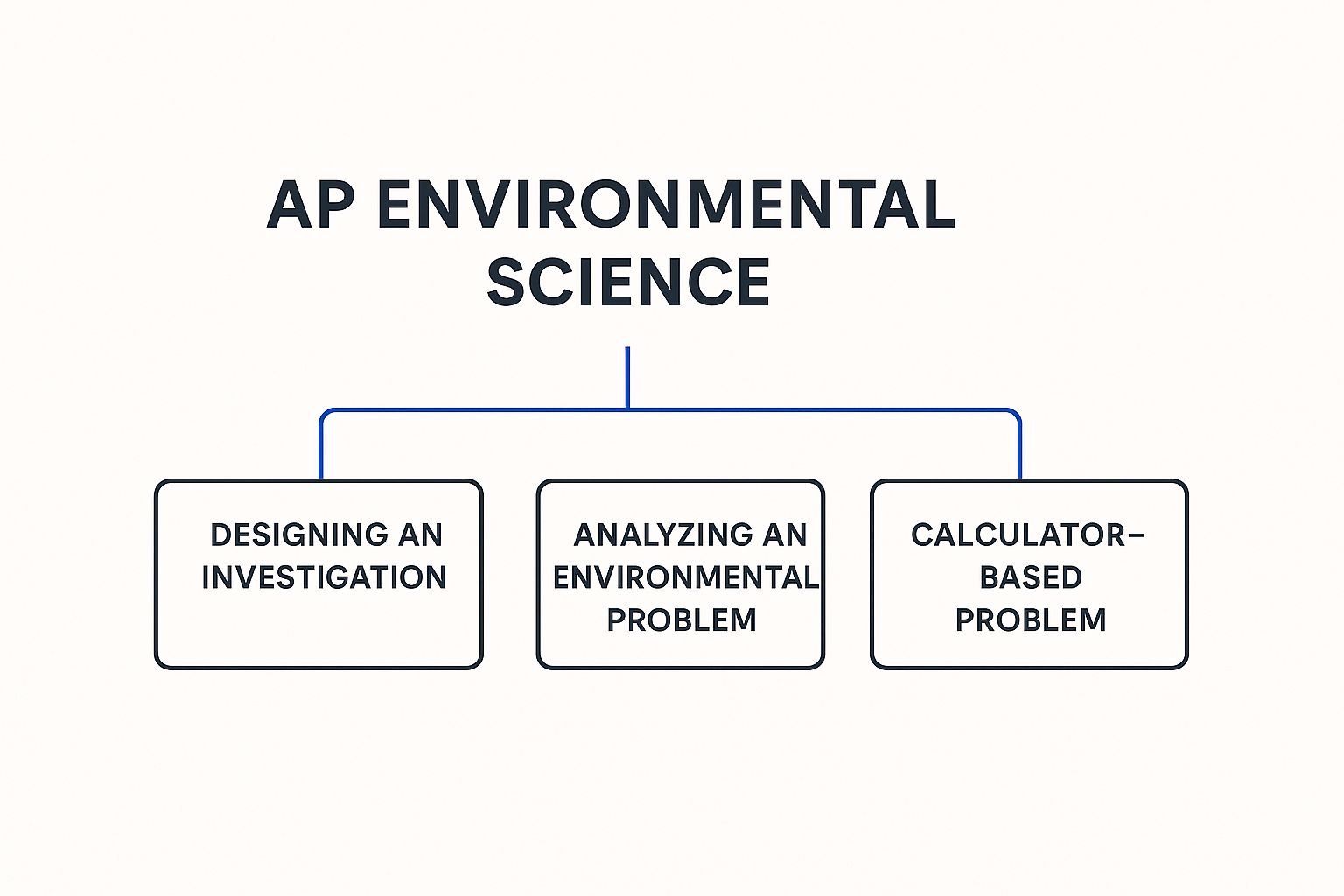
As you can see, each FRQ has a unique focus, starting with experimental design, moving to problem analysis, and finishing with some quantitative reasoning.
Let’s dive into each one:
- Design an Investigation: This question drops you into an environmental scenario and asks you to design a scientific experiment. You’ll need to identify variables, form a hypothesis, describe a procedure, and explain how you’d collect data. The graders are looking for a logical, valid, and repeatable experimental design.
- Analyze an Environmental Problem: For this one, you’ll be given a model or visual that represents an environmental issue. Your task is to describe the problem, explain its causes and effects, and then propose a realistic solution. The key is to justify your proposal with solid scientific evidence.
- Analyze a Problem with Calculations: This question is similar to the second FRQ but adds a math component. You’ll need to perform calculations related to an environmental problem and—this is important—show all your work, including units. Here’s the kicker: no calculator is permitted. You absolutely have to be comfortable with dimensional analysis and scientific notation to nail this one.
Mastering the Core Environmental Concepts

A lot of students tackle their AP Environmental Science review by trying to memorize the nine units one by one. That’s like learning all the individual parts of a car engine without ever figuring out how they work together to make the car actually move. The truth is, the exam is built to test your ability to connect ideas across the entire curriculum.
The College Board actually structures the course around four foundational “Big Ideas.” Think of these as the major highways connecting all the different towns (the units) on your APES map. Getting a handle on these connections is the real secret to moving beyond rote memorization and genuinely understanding the material.
The key isn’t just knowing what the nitrogen cycle is. It’s understanding how human actions in Unit 5 (Land and Water Use) disrupt it, leading to consequences you’ll see in Unit 8 (Aquatic Pollution).
So, instead of treating the nine units like separate chapters in a textbook, we’re going to explore how they’re all woven together by these core themes. This is the approach that lets you tackle those complex, multi-layered questions that separate a good score from a great one.
The Four Big Ideas That Connect Everything
Every single question you’ll face on the APES exam ties back to one or more of these four themes. If you understand them, you have a framework to organize every fact, cycle, and process you learn.
- Energy Transfer (ENG): This is all about how energy moves through systems. It’s not just about food webs, either. It covers everything from the laws of thermodynamics dictating energy loss at each trophic level (Unit 1) to the efficiency of solar panels versus coal-fired power plants (Unit 6).
- Interactions Between Earth Systems (ERT): This theme is all about the interconnectedness of Earth’s massive processes. Think about how tectonic plate movement (Unit 4) creates mountains, which then influences wind patterns and climate, ultimately shaping the biomes you study back in Unit 1.
- Interactions Between Species and the Environment (EIN): This is the heart and soul of ecology. It explores how organisms interact with each other and their surroundings—from population dynamics (Unit 3) and biodiversity (Unit 2) to the devastating impacts of invasive species (Unit 9).
- Sustainability (STB): This theme poses the most critical question of the course: How can humans live in a way that doesn’t completely drain the resources future generations will need? It’s the thread that connects everything from sustainable agriculture (Unit 5) to waste reduction (Unit 8) and global climate change solutions (Unit 9).
Building Conceptual Bridges Between Units
Let’s trace a real-world example to see how this works. Take the issue of ocean acidification, a huge topic in Unit 9 (Global Change).
This problem doesn’t exist in a vacuum. It all starts with burning fossil fuels, which you cover in Unit 6 (Energy Resources and Consumption). This pumps massive amounts of CO2 into the atmosphere, throwing a wrench into the carbon cycle you learned about way back in Unit 1 (Ecosystems).
That extra CO2 dissolves into the ocean and messes with its chemistry. The change directly harms marine life with shells, like coral and mollusks, which hammers aquatic biodiversity—a core concept from Unit 2 (The Living World: Biodiversity).
See the chain reaction? An energy choice (Unit 6) disrupts a biogeochemical cycle (Unit 1), which impacts biodiversity (Unit 2), contributing to global change (Unit 9). The absolute best way to review for APES is to practice making these connections over and over again.
A Unit-by-Unit Summary Through the Lens of the Big Ideas
Your review should constantly link the specifics of each unit back to these bigger themes. Here’s a quick breakdown to get your mind thinking this way:
- Units 1-3 (Ecosystems, Biodiversity, Populations): These units are grounded in Energy Transfer and Species Interactions. Your focus should be on how energy flows through food webs and what limits population growth.
- Units 4-5 (Earth Systems, Land/Water Use): Here, Earth Systems and Sustainability take center stage. You should be connecting concepts like soil erosion from bad farming practices to the long-term sustainability of our food supply.
- Units 6-9 (Energy, Pollution, Global Change): These final units are all about Sustainability and Species Interactions (specifically, our human impact). Practice tracing the path from a specific energy source to its pollution and its ultimate effect on the entire planet.
By framing your study sessions around these connections, you start to think like the people who write the test. Come exam day, you’ll be ready to analyze those tricky scenarios and build the well-supported arguments you need to ace it.
Proven Strategies for High-Scoring FRQs
https://www.youtube.com/embed/3K5VsMOTvlY
Let’s talk about the Free-Response Question (FRQ) section. This is where the rubber meets the road on the AP Environmental Science exam, making up a massive 40% of your total score. It’s not just about what you know; it’s about how well you can explain it.
This is where your deep understanding of scientific concepts is put on full display. Rote memorization won’t cut it here. You have to clearly and precisely articulate your knowledge.
Plenty of students stumble in this section. They give vague, one-word answers, forget to show their math step-by-step, or miss one part of a multi-layered question. To lock in those top scores, you need a solid game plan for tackling every FRQ that comes your way.
Strategy 1: Deconstruct the Prompt and Action Verbs
Before your pen even hits the paper, you need to play detective. Your first job is to break down the prompt and figure out exactly what it’s asking you to do. The College Board uses specific action verbs as signals, telling you precisely what graders are looking for in your answer.
Getting these verbs wrong is an easy way to lose points. For instance, “identify” just means you need to point something out. But “describe” requires you to add details and characteristics. “Explain” goes a step further, asking you to connect the dots and show the “why” behind a concept. For a deeper dive into these crucial command words, check out our complete guide on how AP exam FRQs work.
Make it a habit to underline these action verbs and number the different parts of the question. It’s a simple trick that ensures you don’t accidentally skip over a section and leave points behind.
To help you get a better handle on this, we’ve put together a quick-reference guide for the most common FRQ action verbs.
| Action Verb | What Graders Expect You to Do |
|---|---|
| Identify | State a specific factor, concept, or process. It’s a quick, direct answer. |
| Describe | Provide the relevant characteristics of a topic. Paint a picture with details. |
| Explain | Show the “how” or “why.” Connect cause and effect or explain a process. |
| Propose a Solution | Offer a realistic and specific solution to an environmental problem. |
| Justify | Support your answer with evidence or reasoning. Back up your claim. |
| Calculate | Solve a mathematical problem. You must show all your work and units. |
Knowing these terms inside and out is the first step to crafting a response that directly answers the prompt and maximizes your score.
Strategy 2: Master the Investigation Design FRQ
The very first FRQ you’ll face will ask you to design a scientific experiment. Graders want to see a logical, controlled, and repeatable investigation. Your answer has to hit a few key points to earn full credit.
Here’s what every solid experimental design needs:
- A Testable Hypothesis: A clear “if… then…” statement that directly answers the research question.
- Identify Your Variables: You must explicitly name your independent variable (the one you change), your dependent variable (the one you measure), and at least two constants (things you keep the same to ensure a fair test).
- A Clear Procedure: Briefly outline the steps. The goal is clarity—another student should be able to replicate your experiment just from your description.
- Describe Data Collection: Explain what data you’ll be gathering and how you’ll measure it.
Your experiment doesn’t need to be some Nobel Prize-winning breakthrough. It just needs to be scientifically sound. Focus on showing you understand the principles of a controlled experiment. Simplicity and clarity are your best friends here.
Strategy 3: Structure Your Problem Analysis Responses
The second and third FRQs ask you to analyze an environmental problem, and the third one throws some math into the mix. To succeed, you need to connect evidence to a claim and propose a well-thought-out solution.
Structure is key. Start by accurately describing the environmental issue using specific vocabulary from the course. Then, explain the causes and effects, making direct links between different concepts.
When you’re asked for a solution, be specific. A vague answer like “reduce pollution” is going to get you zero points. Instead, propose a concrete policy, technology, or behavioral change and justify why it would actually work.
Strategy 4: Show Your Math—No Calculator Needed
The math-based FRQ can feel intimidating, especially since you can’t use a calculator. But don’t panic. The calculations are usually just straightforward arithmetic that you can do by hand. The real skill being tested here is dimensional analysis.
Always, always show your work. Every single step. And make sure every number has a unit attached to it. When you set up your problem, arrange the conversions so that the units cancel out, leaving you with the correct unit for your final answer. This method guides you to the solution.
Even if you mess up the final number, you can still get partial credit for a correct setup. It’s also a great idea to practice using scientific notation for really big or small numbers—it makes the math way easier and reduces the chance of silly errors.
Building Your Personalized APES Study Plan
Hoping for a high score on the APES exam without a game plan is like trying to navigate a complex ecosystem without a map. A truly effective review needs a personalized approach, one that zeros in on your specific strengths and weaknesses. The best way to start? A candid self-assessment.
Kick things off by taking a full-length, timed practice exam from a reliable source. Don’t worry about getting a perfect score; the goal here is to collect data. Once you’re done, grade it honestly and analyze the results to pinpoint exactly which of the nine units are giving you the most trouble.
Designing Your Study Timeline
Your timeline is the backbone of your entire study plan. Whether you have six months or just six weeks, you have to be smart about how you divide your time between content review, MCQ drills, and timed FRQ sessions. Let’s break down two common approaches you can adapt for yourself.
The Marathon Plan (3+ Months)
This long-term strategy is perfect for steady, comprehensive prep. It gives you the space to use powerful learning techniques that actually make the knowledge stick, instead of just cramming facts at the last minute.
- Weeks 1-2: Dive into your weakest units first, based on that initial practice test. Spend a few days on each one, really focusing on understanding the core concepts, not just memorizing terms.
- Ongoing: Make spaced repetition your best friend. After you study a unit, circle back to it a few days later, then a week later, then a few weeks after that. This technique is proven to move information from short-term to long-term memory.
- Weekly: Set aside one session each week just for practice. Alternate between a set of MCQs and one timed FRQ to build your test-taking stamina and get comfortable with the question formats.
The Sprint Plan (6 Weeks or Less)
If you’re running short on time, your focus has to be on high-yield activities. This plan is all about prioritizing the most heavily weighted units and practicing relentlessly to get you exam-ready, fast.
- Prioritize Units: Concentrate your review on the units that make up the biggest chunks of the exam: Unit 9 (Global Change), Unit 5 (Land and Water Use), and Unit 4 (Earth Systems and Resources).
- Practice, Practice, Practice: At this point, working through timed practice questions is way more valuable than just rereading your textbook. Aim for at least three dedicated practice sessions per week.
- Analyze Your Mistakes: Every time you get a question wrong, don’t just glance at the right answer. Dig into why you got it wrong and figure out which concept you need to go back and review.
Using Active Recall to Supercharge Your Sessions
Just rereading your notes is one of the least effective ways to study. You need to be practicing active recall—the mental workout of actively pulling information from your brain. Think of it as lifting weights for your memory; it strengthens those neural pathways and makes the information much easier to access on exam day.
The difference between passive review and active recall is the difference between watching a documentary about hiking and actually climbing the mountain. One gives you information; the other builds the strength and skill you need to succeed.
Here are a few simple ways to build active recall into your APES study routine:
- Concept Mapping: After reviewing a unit, put your notes away and draw a concept map from memory. Try to connect all the key ideas, cycles, and environmental laws.
- Teach a Concept: Find a friend or family member who knows nothing about APES and try to explain a complex topic, like the tragedy of the commons or ocean acidification. If they get it, you really get it.
- Blank Paper Review: Grab a blank piece of paper and write down absolutely everything you can remember about a specific unit. Then, compare it to your notes to see what you missed.
Building a personalized study plan takes some effort up front, but the payoff is huge. For those navigating this journey on their own, our guide on succeeding with AP exam self-studying offers even more strategies for staying on track and acing the exam.
APES Exam FAQs
As you put the finishing touches on your AP Environmental Science review, it’s totally normal to have a few last-minute questions pop up. We get it. This section is here to tackle some of the most common things students wonder about, giving you clear, straightforward answers so you can walk into the exam feeling ready for anything.
Think of this as your final check-in. Let’s clear up any lingering questions you might have.
How Much Math Is on the AP Environmental Science Exam?
Math is a small but critical part of the APES exam. You’re not going to see any complex calculus, but you absolutely need to be comfortable with basic calculations—without a calculator. You can expect math questions to appear in both the multiple-choice and free-response sections.
In fact, one of the three FRQs is guaranteed to have a math component. To really nail these questions, you need to master a few key skills:
- Dimensional Analysis: This is your most important math tool for APES. It’s all about converting units (like gallons to liters or miles to kilometers) by setting up fractions so the units you don’t want cancel out.
- Percentages and Proportions: You’ll definitely need to calculate things like percentage change and efficiency, and solve simple proportion problems.
- Scientific Notation: Dealing with huge or tiny numbers is common, especially when you’re working with data on energy or pollution.
- Key Formulas: Make sure you’ve memorized specific formulas like the Rule of 70 for figuring out population doubling time and how to do half-life calculations for radioactive decay.
The key to success here isn’t being a math whiz. It’s about being able to logically set up the problem and show every single step of your work.
Which APES Units Are Most Important to Review?
While technically any topic from any unit can show up, some units definitely pack more of a punch on the exam. If you’re crunched for time and need to prioritize, this is where you should focus your energy.
Looking back at past exams, these units are consistently the most heavily tested:
- Unit 9: Global Change (15–20%)
- Unit 5: Land and Water Use (10–15%)
- Unit 4: Earth Systems and Resources (10–15%)
- Unit 6: Energy Resources and Consumption (10-15%)
- Unit 3: Populations (10-15%)
But here’s the thing: the exam is built around interconnected “Big Ideas.” A question about air pollution from Unit 7 could easily tie back to energy choices in Unit 6 and how that impacts biodiversity from Unit 2. A truly great review connects the dots across all nine units.
So, the smartest strategy is a balanced one. Give these high-weight units some extra love, but also work on strengthening your understanding of how they all link together.
What Is the Best Way to Prepare for the FRQ Section?
The single best thing you can do to prepare for the FRQs is to practice, practice, practice with official past exam questions released by the College Board. Seriously, this is non-negotiable if you’re aiming for a high score.
When you sit down to practice, simulate the real thing. Set a timer for 70 minutes and tackle all three questions. This is crucial for building the mental stamina and time management skills you’ll need on exam day.
Once you’re done, don’t just glance at the answers. Meticulously go through the official scoring guidelines. Pay close attention to how points are awarded for specific phrases, calculations, and explanations. This process is gold—it literally trains you to think like a grader, showing you exactly what they’re looking for and where students commonly lose points. Always write in full, clear sentences; bullet points or fragments almost never get full credit.
Ready to turn your hard work into a top score? Magna Education‘s AI-powered platform provides personalized practice, instant feedback, and targeted review to help you master every APES concept. Students using Magna improve their odds of scoring a 5 by over 3X. Start your journey to a 5.
AP is a registered trademark of College Board