

If you’ve ever felt like textbooks and lectures have their own secret language, you’re not wrong. That language is academic vocabulary, and it’s the specialized set of words used in classrooms, scholarly articles, and academic discussions to tackle complex subjects. This is a guide to academic vocabulary definition and will help you be prepared for your AP exams.
What Is Academic Vocabulary Really
It’s easy to mistake academic vocabulary for highly specific, technical jargon—words like osmosis in biology or tectonic in geology. While those are important, they aren’t the whole picture.

Think of true academic vocabulary as the versatile toolkit for scholarly conversation. It’s made up of high-utility words like analyze, synthesize, and evaluate that show up across nearly every discipline.
These are the words that bridge the gap between our everyday conversational language and the formal, precise language of education. When students master them, they can move beyond just knowing a topic and start engaging with it on a critical level.
The Words That Build Arguments
So, how do we know which words are the most important? Researchers have done the heavy lifting for us with the Academic Word List (AWL). This isn’t just a random collection of smart-sounding words.
The AWL was carefully curated from a massive analysis of 3.5 million words from academic texts across fields like science, economics, and law. It identifies 570 word families that consistently appear in scholarly writing, making up about 10% of all the words students will encounter. If you’re curious, you can dig into the research behind the AWL’s creation and composition.
By learning the words on the AWL, students get a massive boost in reading comprehension. These terms are the very building blocks of academic arguments and discussions.
Ultimately, understanding academic vocabulary is about more than just memorizing definitions. It’s about gaining the power to read, write, and think with the clarity and precision needed to succeed in higher education and beyond.
To make this crystal clear, let’s break down the different types of vocabulary students will run into.
General vs Academic vs Technical Vocabulary
This quick comparison helps clarify where academic vocabulary fits in a student’s learning journey.
| Vocabulary Type | Description | Example |
|---|---|---|
| General | Everyday words used in casual conversation. High-frequency and familiar. | happy, run, big, because |
| Academic | High-utility words found across different subjects. Used for analysis and argument. | analyze, evidence, valid, consistent |
| Technical | Highly specialized, domain-specific terms used within one particular field. | photosynthesis, stoichiometry, algorithm |
As you can see, academic words act as the essential bridge, allowing students to use their general language skills to understand and discuss technical subjects with precision. They are the key to unlocking a deeper level of learning.
Why Mastering Academic Vocabulary Matters
It’s one thing to know the dictionary definition of academic vocabulary, but it’s another thing entirely to grasp its real-world impact. Think of it less like a list of words to memorize and more like a specialized toolkit. Without the right tools, you can’t deconstruct a complex scientific theory, build a persuasive historical argument, or fully appreciate the nuance in a piece of literature.
Mastering this vocabulary is what helps students shift from being passive consumers of information to becoming active, critical thinkers. It’s the bridge between simply knowing facts and being able to analyze, question, and contribute to the bigger conversation. That leap is everything when it comes to success in college and beyond.
Boosting Student Performance
The link between a strong academic vocabulary and student achievement is direct and easy to see. When students command this language, their performance improves across the board. In fact, research shows that academic word knowledge explains a whopping 16% of the variance in reading comprehension scores. That’s a huge piece of the puzzle. If you want to dig deeper into how these skills support each other, you can explore the full research on reading comprehension and vocabulary.
A robust academic vocabulary doesn’t just help students understand texts; it gives them the precise language needed to articulate their own complex ideas, a skill essential for high-level writing and class discussions.
The infographic below really brings home the direct impact of vocabulary mastery on key student outcomes.
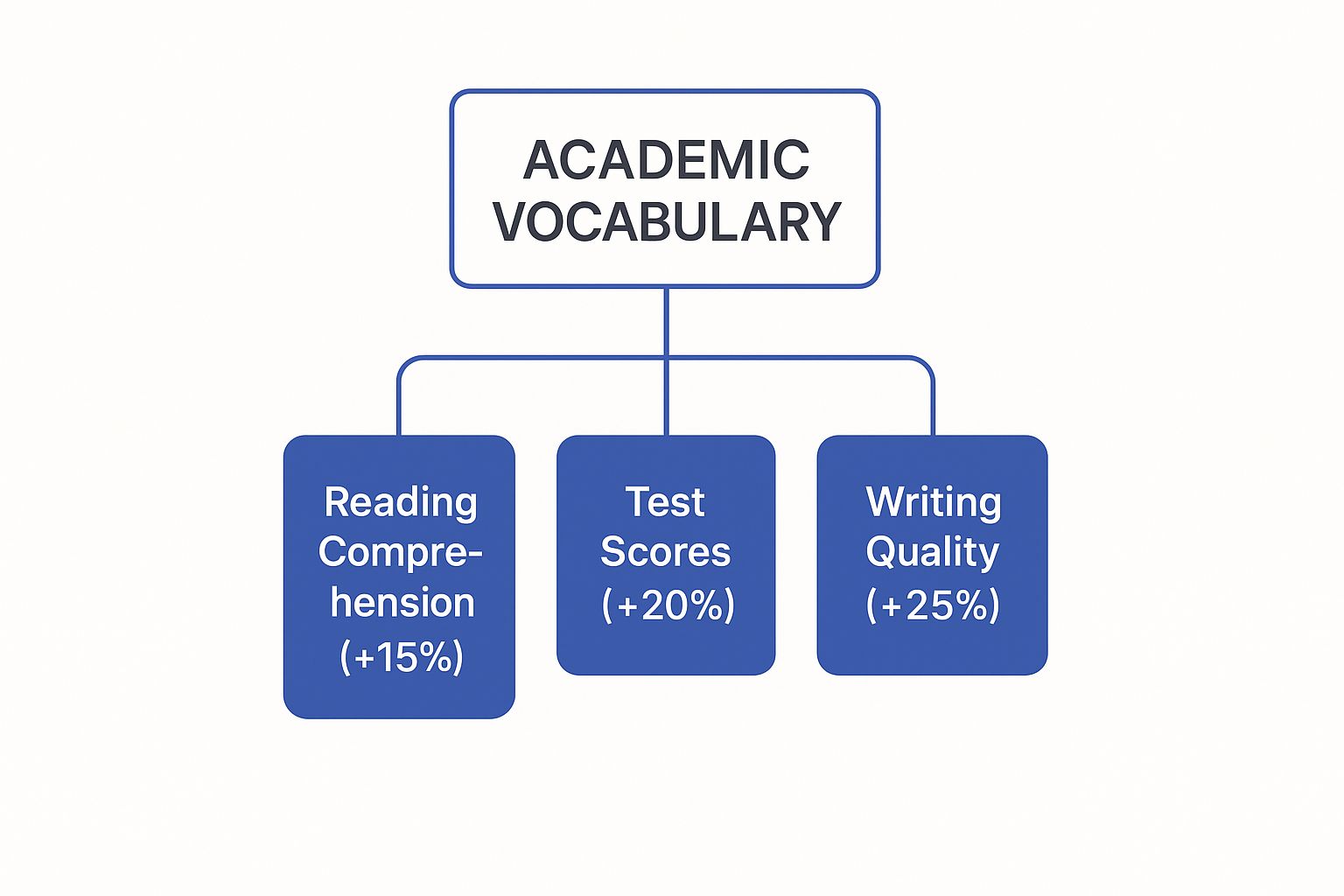
As the data shows, vocabulary is a powerful lever for improving how students read, test, and write. At the end of the day, these words are the currency of knowledge and critical thinking.
The Foundation for Lifelong Learning
Building a strong academic vocabulary is an investment that pays dividends long after graduation. It equips learners with the skills to confidently tackle unfamiliar subjects, engage with sophisticated material, and communicate with precision and authority.
This proficiency is crucial for:
- Higher Education: Making sense of dense research papers and contributing meaningfully to seminar discussions.
- Career Advancement: Writing clear reports, understanding industry-specific literature, and communicating effectively with colleagues.
In short, mastering academic vocabulary gives students the linguistic tools they need to build a solid foundation for lifelong learning and professional achievement. It’s truly one of the most vital skills they can develop.
Getting a Handle on the Tiers of Academic Vocabulary
Let’s be real: trying to learn every “academic” word at once is a recipe for burnout. It’s overwhelming. A much smarter way to go about it is to think of these words in different categories, or tiers. This simple framework makes the whole process feel way more manageable for teachers and students alike.
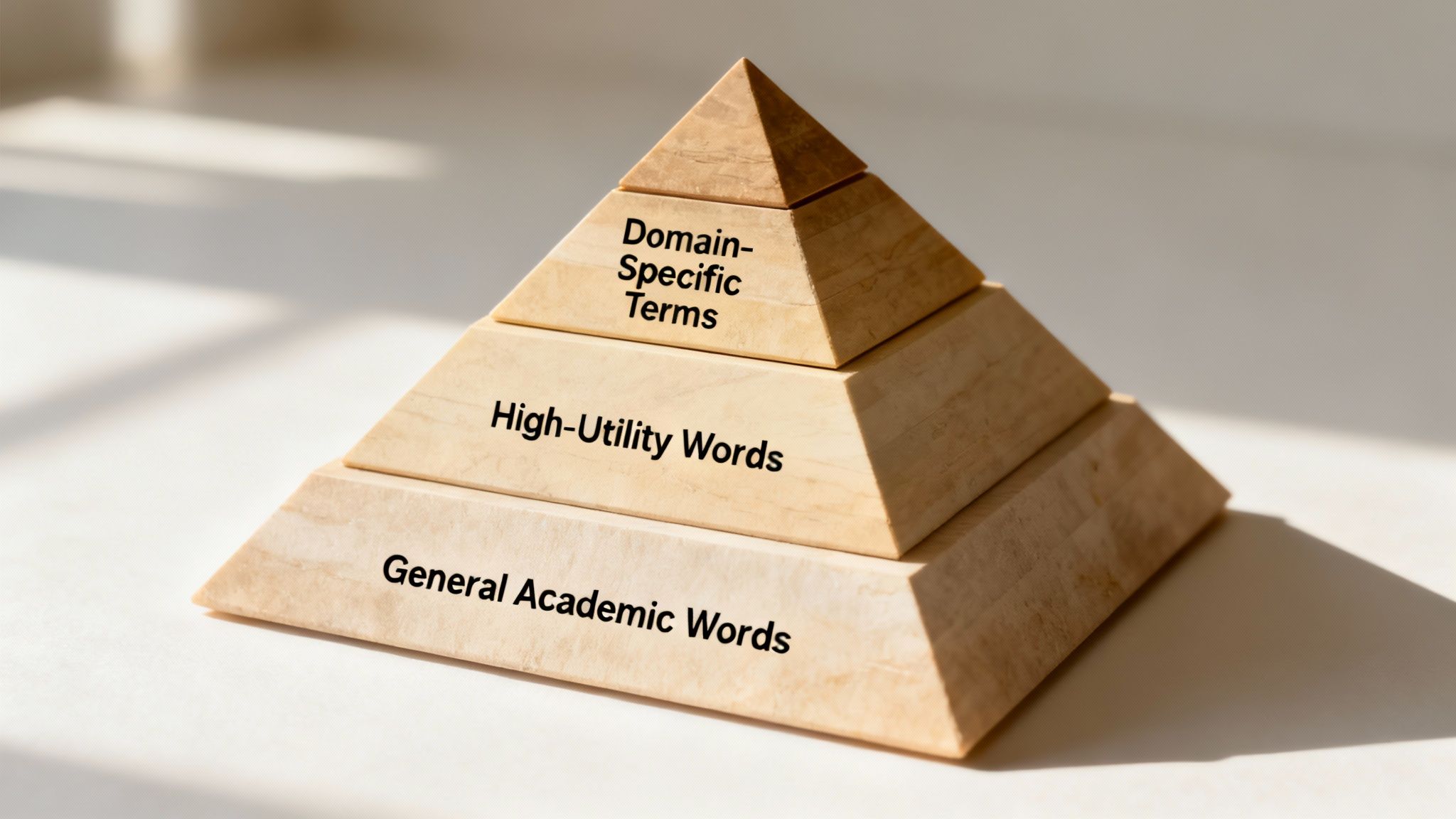
The biggest split is between the general academic words you can use almost anywhere and the highly specific ones tied to a single subject. One is like a multi-tool for your brain; the other is a specialized instrument you only pull out for certain jobs.
General Academic Words
These are your workhorse words—high-frequency, high-utility terms that pop up across nearly every academic subject. We’re talking about words like analyze, framework, theory, and interpret. They’re the nuts and bolts of scholarly arguments, essential for critical thinking whether you’re dissecting a poem or a physics problem.
Getting a grip on these words first gives you the biggest bang for your buck. Why? Because they unlock texts in history, science, literature, you name it.
Domain-Specific Vocabulary
Now we’re getting into the specialized stuff. This bucket holds the words unique to a single field of study. It’s the technical jargon you need to talk about a subject with any real precision.
Think of words like:
- Biology: osmosis, photosynthesis, mitosis
- Literature: sonnet, metaphor, iambic pentameter
- Economics: inflation, GDP, fiscal policy
You won’t see these words as often, but when you’re in their territory, they are absolutely non-negotiable for deep understanding.
A solid game plan is to focus on the versatile general academic words first. Once you’ve built that strong foundation, tackling the more niche, domain-specific terms feels a whole lot less intimidating.
It’s crucial to remember that true academic vocabulary is a mix of both. In fact, research suggests that these academic words—both general and specific—make up about 10% of all words you’ll find in academic texts. That’s a huge chunk, underscoring just how important they are. For a deeper dive, check out these insights on academic vocabulary size.
By breaking vocabulary down into these tiers, students can build their word banks strategically, starting with the words that will give them the most leverage on their learning journey.
Putting Academic Words into Practice
Knowing the theory behind academic vocabulary is one thing, but seeing how these words actually work in the wild is where the magic happens. Think of them as precision tools. Each one is designed for a specific job, helping you build a stronger, clearer argument.
The real goal is to move from just memorizing definitions to actually using these words. That’s how you unlock their power.
From Abstract to Actionable
Let’s break down a few high-impact academic words to see them in action. This hands-on approach cuts through the jargon and shows you just how flexible they can be.
Take the word synthesize. It might sound a bit lofty, but it really just means combining different things to create something new.
- In a history class, you might synthesize information from letters, government documents, and scholarly articles to build a fresh argument about what caused a historical event.
- In a biology lab, a scientist might synthesize data from several experiments to propose a new theory about how cells work.
Next up, paradigm. It’s a fancy word for a model, a framework, or just the standard way of looking at something.
- Science: The jump from an Earth-centered to a sun-centered model of the universe was a massive paradigm shift in astronomy.
- Humanities: Postmodern novels challenged the existing paradigm of storytelling by playing with scrambled timelines and narrators you couldn’t always trust.
And finally, subsequent. This one’s straightforward—it just means “coming after something else.” It’s perfect for showing a clear sequence of events.
- An initial experiment showed an unexpected result, and subsequent tests were designed to figure out why.
- The author’s first novel was a huge hit, but her subsequent books never quite matched that early success.
Using these words correctly doesn’t just make you sound smarter—it lets you express complex ideas with incredible precision. It’s a critical skill for writing any kind of compelling essay, report, or analysis.
To show how a single word can adapt, let’s look at how it might appear across different academic fields.
Academic Vocabulary in Action Across Disciplines
Here’s a quick table showing how one word can be a chameleon, fitting into different subjects to communicate big ideas.
| Academic Word | Meaning in Simple Terms | Example Sentence (Science) | Example Sentence (Humanities) |
|---|---|---|---|
| Correlate | To have a mutual relationship or connection. | The study found that high levels of pollution directly correlate with an increase in respiratory illnesses. | Historians have found that periods of economic instability often correlate with a rise in political extremism. |
| Implication | A likely consequence of something. | The implication of the fossil discovery is that this species is much older than previously thought. | The novel’s final chapter has a profound implication for the protagonist’s moral journey. |
| Critique | A detailed analysis and assessment. | The research paper offers a critique of the existing methodology for measuring dark matter. | The film essay provides a sharp critique of consumer culture as depicted in classic cinema. |
Seeing these words in context transforms them from abstract concepts into tangible tools you can use in your own writing.
By actively practicing with words like these, you build the kind of fluency that’s essential for academic success. It’s also a core part of preparing for major exams. For more tips on that front, check out our guide on how to ace your AP exams with effective study strategies.
Effective Strategies to Build Academic Vocabulary
Knowing what academic vocabulary is marks the starting line, but the real race is actively building and holding onto it. Let’s be honest: memorizing flashcards just doesn’t cut it for long-term mastery. The methods that actually work involve getting your hands dirty with the words, seeing them everywhere, and putting them to use in meaningful ways.

The goal here is simple but challenging. We need to move words from your passive vocabulary (words you recognize when you see them) to your active vocabulary (words you can pull out of thin air and use confidently). That transition doesn’t happen by accident; it demands deliberate, structured practice that goes way beyond just knowing a definition.
Move Beyond Rote Memorization
To truly make a new word your own, you have to interact with it from multiple angles. This is how you get a feel for its subtleties and lock it into your long-term memory.
Kick things off with these proven techniques:
- Targeted Academic Reading: Don’t just read—go on a word hunt. When a new term pops up in a textbook or scholarly article, stop and analyze how it’s being used. What’s its function in that specific sentence?
- Use Contextual Clues: Before you instinctively grab a dictionary, try to deduce a word’s meaning from the surrounding text. This little bit of active problem-solving makes the definition far more memorable.
- Keep a Vocabulary Journal: Grab a notebook and dedicate it to new words. For every word, write down its definition in your own words, a synonym, and an original sentence that uses it correctly.
This kind of hands-on learning is what builds a vocabulary that’s both broad and deep. It’s also a cornerstone of creating a productive learning environment for advanced students, where genuine engagement always trumps surface-level memorization.
The most powerful strategy of all is active recall. Don’t just glance at your word list. Challenge yourself to weave new terms into class discussions, essays, and presentations. The very act of retrieving and applying a word cements it in your mind.
Implement Structured Learning Routines
For both educators and self-starters, structured routines can seriously accelerate vocabulary growth. This is especially true for students in preparatory programs who need to make big gains, fast.
Focused programs can deliver impressive results quickly. One study found that international students in a six-month intensive program showed significant progress in their use of academic words, proving just how effective structured instruction can be. You can read more about these findings on academic vocabulary productivity.
By blending consistent exposure with active practice, anyone can build a strong command of academic language. Soon enough, you’ll find that those complex texts are no longer intimidating challenges, but opportunities for deeper understanding.
How Our Understanding of Academic Language Has Evolved
The way we think about academic vocabulary isn’t set in stone. Decades ago, our best tools were static, handcrafted word lists. They were helpful, sure, but also pretty limited. Think of them as hand-drawn maps of the academic world—useful for getting your general bearings but missing the details you need for a precise journey.
Today, our methods are way more dynamic, all thanks to the power of data. Researchers now dive into massive digital collections of texts, called corpora, to analyze millions of words as they’re actually used. This shift is like upgrading from a paper map to a live GPS. It gives us a constantly updated, data-driven view of the words that truly matter in scholarly conversations.
From Static Lists to Living Language
You can see this evolution perfectly in the story of the Academic Word List (AWL). When it was first created back in the 1990s, it was based on a 3.5 million-word corpus. Fast forward to today, and it has been refined using modern corpora that are ballooning past 120 million words. As our tech gets better, so does our insight into the real language of academia. You can dig deeper into the research on vocabulary size and academic growth if you’re curious.
This whole data-backed approach just reinforces a simple but powerful truth: one of the best ways to build a strong vocabulary is through consistent, extensive reading.
Academic vocabulary isn’t a finite set of terms to memorize. It’s a living, breathing part of language. Acquiring it is a lifelong process of discovery, not a one-time task you just check off a list.
This journey from fixed lists to big data helps us appreciate the tools we have now. The use of AI in education, for instance, builds on this very foundation. In fact, leading AI platforms are getting noticed for their impact, like when Magna Education’s AI platform wins a prestigious 2025 EdTech award.
Ultimately, looking back shows us that our definition of academic vocabulary has to be flexible, adapting as our understanding of language itself gets deeper.
Ready to see how modern technology can accelerate AP success? Discover how Magna Education’s AI-powered platform helps students and teachers master complex subjects and prepare for exams with confidence. Explore our solutions at https://magnaeducation.ai.
AP is a registered trademark of College Board.